Entree: Japan – Kansai / Osaka-Kyoto – きつねうどん ➤ Kitsune Udon (Udon noodle soup in light dashi broth topped with sweet-simmered fried tofu pockets)
Food safety reminder: Follow safe food-handling practices and use a food thermometer to verify safe internal cooking temperatures.
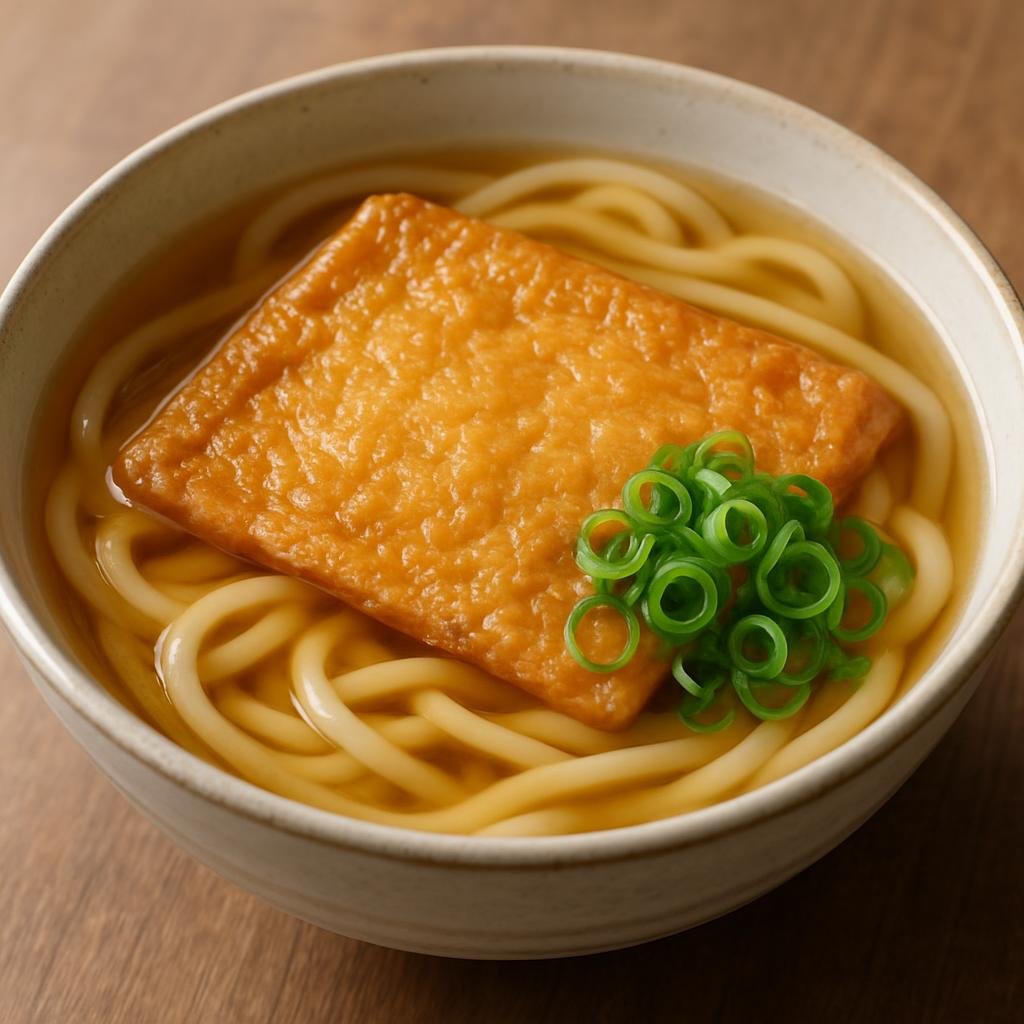
Serving Size: 4
Approximate Time
Prep
15 min
Cook
18 min
Total
33 min
Ingredients
US weight measurements (approximate). oz means weight ounces, not fluid ounces.
- 12 oz fresh or frozen udon noodles (or 10 oz dried udon)
- 8 cups (1.9 L) dashi stock (kombu and katsuobushi stock)
- 1/4 cup (60 ml) light soy sauce (usukuchi shoyu if available)
- 3 tbsp (45 ml) mirin
- 1 tbsp (15 ml) sake (optional)
- 1 tbsp granulated sugar
- 6 aburaage pockets (sweet fried tofu), approx. 6 oz total
- 1/2 cup (120 ml) dashi or water for simmering aburaage
- 1/4 cup (60 ml) soy sauce for simmering aburaage
- 2 tbsp (30 ml) mirin for simmering aburaage
- 2 tbsp granulated sugar for simmering aburaage
- 4 green onions (scallions), thinly sliced
- Shichimi togarashi or grated ginger for serving (optional)
Show original ingredient measurements
- 12 oz (340 g) fresh or frozen udon noodles (or 10 oz / 285 g dried udon)
- 8 cups (1.9 L) dashi stock (kombu and katsuobushi stock)
- 1/4 cup (60 ml) light soy sauce (usukuchi shoyu if available)
- 3 tbsp (45 ml) mirin
- 1 tbsp (15 ml) sake (optional)
- 1 tbsp (12 g) granulated sugar
- 6 aburaage pockets (sweet fried tofu), approx. 6 oz (170 g) total
- 1/2 cup (120 ml) dashi or water for simmering aburaage
- 1/4 cup (60 ml) soy sauce for simmering aburaage
- 2 tbsp (30 ml) mirin for simmering aburaage
- 2 tbsp (25 g) granulated sugar for simmering aburaage
- 4 green onions (scallions), thinly sliced
- Shichimi togarashi or grated ginger for serving (optional)
Instructions
Gram weights below are shown as approximate US weights.
1. Prepare the aburaage: cut each pocket in half to open, briefly blanch in boiling water for 30 seconds and drain to remove excess oil, then gently press out extra water.
2. In a small saucepan, combine 1/2 cup (120 ml) dashi or water, 1/4 cup (60 ml) soy sauce, 2 tbsp (30 ml) mirin, and 2 tbsp sugar. Add the aburaage pockets and simmer over low heat, turning occasionally, until the pockets absorb the liquid and become glossy and sweet, about 8–10 minutes. Remove and keep warm.
3. Make the broth: in a separate pot bring 8 cups (1.9 L) dashi to a gentle simmer. Stir in 1/4 cup (60 ml) light soy sauce, 3 tbsp (45 ml) mirin, 1 tbsp (15 ml) sake if using, and 1 tbsp sugar. Taste and adjust to a lighter, more delicate balance typical of Kansai style.
4. Cook the udon noodles according to package instructions until just tender. Drain and divide the noodles among four warm bowls.
5. Reheat the broth briefly and pour over the noodles. Place one or two aburaage pockets on top of each bowl, sprinkle with sliced green onions, and finish with a pinch of shichimi or a little grated ginger if desired. Serve immediately.
Show original instructions
1. Prepare the aburaage: cut each pocket in half to open, briefly blanch in boiling water for 30 seconds and drain to remove excess oil, then gently press out extra water.
2. In a small saucepan, combine 1/2 cup (120 ml) dashi or water, 1/4 cup (60 ml) soy sauce, 2 tbsp (30 ml) mirin, and 2 tbsp (25 g) sugar. Add the aburaage pockets and simmer over low heat, turning occasionally, until the pockets absorb the liquid and become glossy and sweet, about 8–10 minutes. Remove and keep warm.
3. Make the broth: in a separate pot bring 8 cups (1.9 L) dashi to a gentle simmer. Stir in 1/4 cup (60 ml) light soy sauce, 3 tbsp (45 ml) mirin, 1 tbsp (15 ml) sake if using, and 1 tbsp (12 g) sugar. Taste and adjust to a lighter, more delicate balance typical of Kansai style.
4. Cook the udon noodles according to package instructions until just tender. Drain and divide the noodles among four warm bowls.
5. Reheat the broth briefly and pour over the noodles. Place one or two aburaage pockets on top of each bowl, sprinkle with sliced green onions, and finish with a pinch of shichimi or a little grated ginger if desired. Serve immediately.
Estimated Nutritional Information*
Per serving | Servings: 4
Calories: 326 kcal
Carbohydrates: 59.2 g
Protein: 11.5 g
Fat: 4.2 g
Sodium: 2257 mg
Generated: 2026-11-05T19:51:34+00:00
*Values are estimates based on USDA data and mathematical calculations. Actual values may vary. Where data are unavailable, those contributions are excluded.