Entree: Kiribati – Southern Culinary Region – Te Ika (Whole island-style fish cooked with coconut milk, root vegetables, and island herbs)
Food safety reminder: Follow safe food-handling practices and use a food thermometer to verify safe internal cooking temperatures.
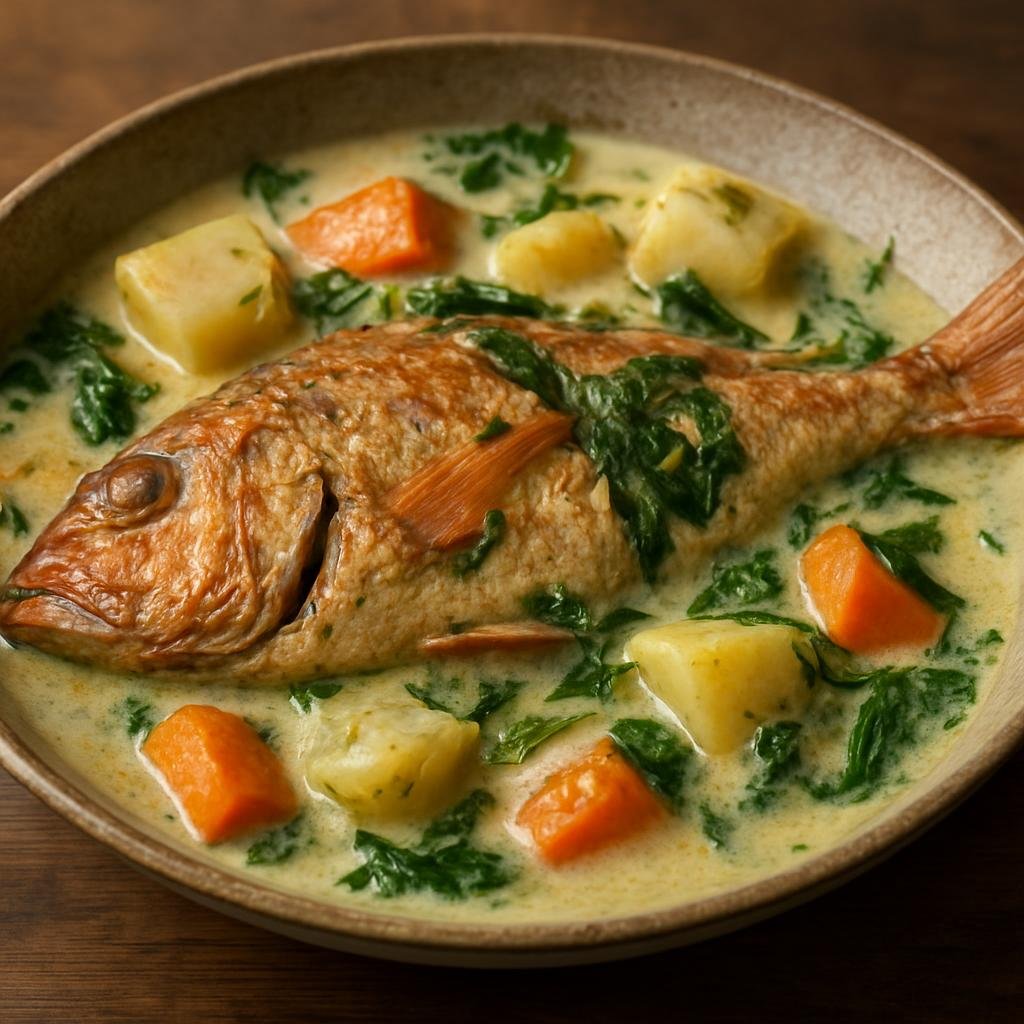
Serving Size: 4
Approximate Time
Prep
15 min
Cook
35 min
Total
50 min
Ingredients
1 whole cleaned and scaled reef fish, about 900 g gross; estimate 450 g edible raw red snapper for the nutrition estimate (species and edible yield are examples/assumptions)
450 g peeled taro, cut into 2.5 cm pieces (estimated edible portion: 450 g)
1 medium onion, about 110 g, thinly sliced
3 garlic cloves, about 9 g, crushed
15 g fresh ginger, finely grated
400 ml (about 400 g) canned coconut milk
30 ml (about 30 g) lime juice
30 ml (about 27 g) vegetable oil
5 g sea salt
2.5 g black pepper, freshly ground
1 small chili, about 10 g, sliced (optional) (estimated edible portion: 10 g)
30 ml (about 8 g) fresh cilantro, chopped
2 bay leaves, about 0.4 g (optional, for aroma)
Instructions
1. Preheat the oven to 190°C. Pat the cleaned and scaled fish dry and score each side with 2–3 diagonal cuts. Season the fish inside and out with 2.5 g of the salt and 1.25 g of the black pepper.
2. Mix the garlic, ginger, lime juice, and half of the vegetable oil. Rub half of this mixture into the fish cavity and over the fish; reserve the rest for the vegetables.
3. Arrange the taro and onion in a roasting pan. Toss with the reserved garlic-ginger mixture, the remaining oil, the remaining 2.5 g salt, and the remaining 1.25 g black pepper. Add the sliced chili if using, and tuck in the bay leaves if using.
4. Place the fish on top of the vegetables. Pour the coconut milk evenly over the fish and vegetables, then sprinkle the chopped cilantro over the top.
5. Cover the pan tightly with foil or a lid and bake for 30–35 minutes, until the taro is tender and the fish flakes easily. Check that the fish is fully cooked; cooking time may vary with its shape and thickness.
6. Remove from the oven and rest for 5 minutes. Carefully transfer the fish and vegetables to a serving platter, spoon the coconut-taro sauce over them, and serve.
Estimated Nutritional Information*
Per serving | Servings: 4
Calories: 547 kcal
Carbohydrates: 40.1 g
Protein: 27.7 g
Fat: 32.3 g
Saturated fat: 22.4 g
Cholesterol: 42 mg
Fiber: 7.6 g
Sugar: 5.2 g
Sodium: 586 mg
Potassium: 1478 mg
Calcium: 116 mg
Iron: 2.66 mg
Vitamin A: 44 µg RAE
Vitamin C: 18.4 mg
Vitamin D: 11.5 µg
Generated: 2026-11-06T06:53:58+00:00
*Values are estimates based on USDA data and mathematical calculations. Actual values may vary. Where data are unavailable, those contributions are excluded.