Entree: France – Auvergne – Salers Beef Steak (Pan-seared beef steak from the Salers breed served with a simple pan sauce and herb butter)
Food safety reminder: Follow safe food-handling practices and use a food thermometer to verify safe internal cooking temperatures.
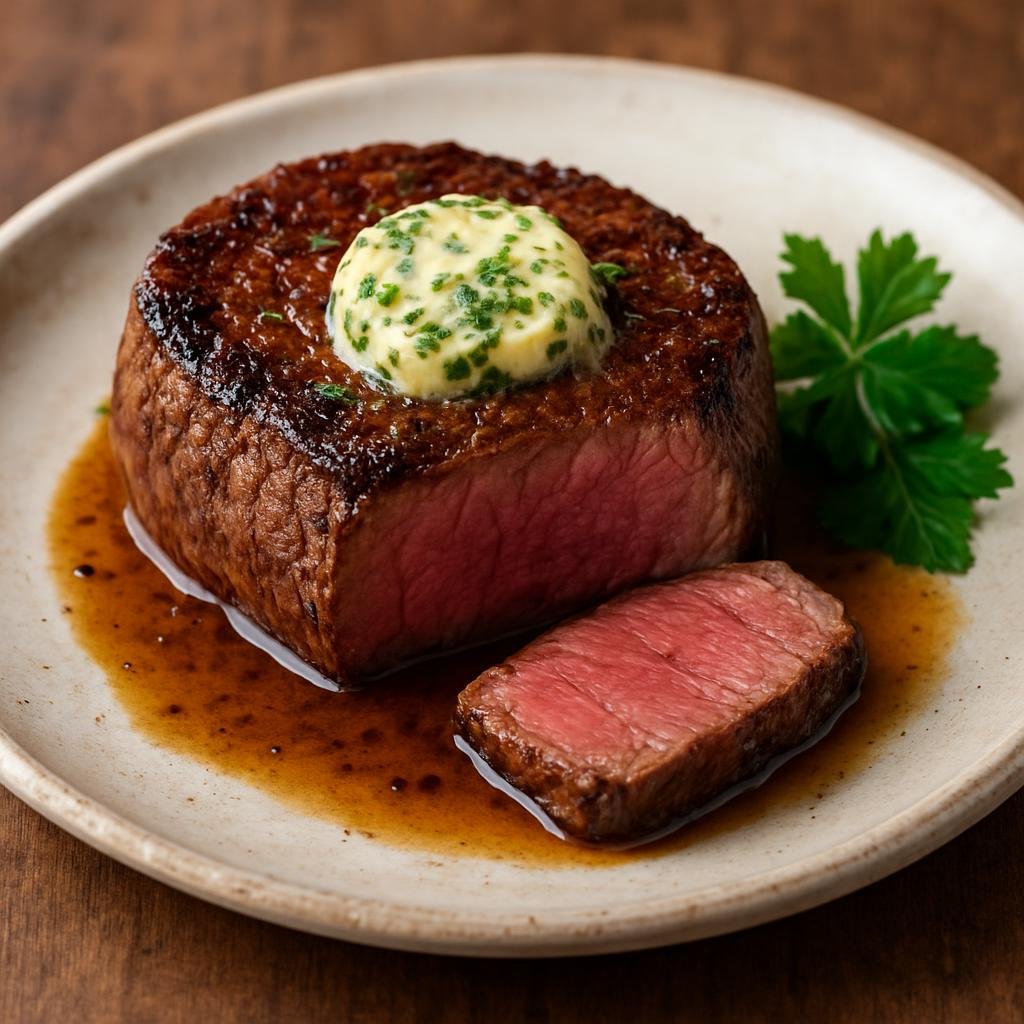
Serving Size: 2
Approximate Time
Prep
10 min
Cook
20 min
Additional
10 min
Total
40 min
Ingredients
- 1 Salers beef steak, approx. 12 oz (340 g) (such as ribeye steak)
- 1 tsp (5 g) coarse sea salt
- 1/2 tsp (1.5 g) freshly ground black pepper
- 1 tbsp (15 ml) neutral oil (vegetable or grapeseed)
- 1 tbsp (15 g) unsalted butter
- 2 cloves (6 g) garlic, lightly crushed
- 2 sprigs (approx. 4 g) fresh thyme
- 1 small shallot, minced, about 1 tbsp (10 g)
- 1/2 cup (120 ml) dry red wine
- 1/2 cup (120 ml) beef stock
- 1 tsp (5 g) Dijon mustard
- 1 tbsp (15 g) cold unsalted butter, cubed for finishing sauce
- 1 tbsp (4 g) chopped fresh parsley for garnish (optional)
Instructions
1. Remove the steak from the refrigerator 30–45 minutes before cooking to come to near room temperature; pat dry and season both sides with coarse salt and black pepper.
2. Heat a heavy skillet or cast-iron pan over high heat until very hot. Add the neutral oil and swirl to coat.
3. Place the steak in the pan and sear without moving for 2–4 minutes until a deep brown crust forms, then flip and add 1 tablespoon butter, crushed garlic, and thyme to the pan; baste the steak with the melted butter for another 2–4 minutes for medium-rare (adjust time for thickness).
4. Transfer the steak to a cutting board and loosely tent with foil to rest for 6–8 minutes.
5. Meanwhile, reduce heat to medium and remove excess fat from the pan, leaving browned bits. Add the minced shallot and cook 1 minute until fragrant.
6. Pour in the red wine to deglaze, scraping up browned bits; reduce by half, then add beef stock and Dijon mustard and simmer until slightly thickened, about 3–5 minutes.
7. Off the heat, whisk in the cold cubed butter until the sauce is glossy; taste and season with salt and pepper as needed.
8. Slice the steak against the grain, arrange on warm plates, spoon pan sauce over, and garnish with chopped parsley and the roasted garlic and thyme from the pan.
Estimated Nutritional Information*
Per serving | Servings: 2
Calories: 624 kcal
Carbohydrates: 4.8 g
Protein: 34.3 g
Fat: 47.7 g
Saturated fat: 21.3 g
Cholesterol: 148 mg
Fiber: 0.9 g
Sodium: 1315 mg
Potassium: 595 mg
Calcium: 49 mg
Iron: 4.16 mg
Vitamin A: 123 µg RAE
Vitamin C: 7.2 mg
Vitamin D: 0.2 µg
Generated: 2026-11-06T04:10:38+00:00
*Values are estimates based on USDA data and mathematical calculations. Actual values may vary. Where data are unavailable, those contributions are excluded.