Entree: Saudi Arabia – Eastern Province – هريس ➤ Harees (Slow-simmered cracked wheat porridge cooked with tender meat and butter)
Food safety reminder: Follow safe food-handling practices and use a food thermometer to verify safe internal cooking temperatures.
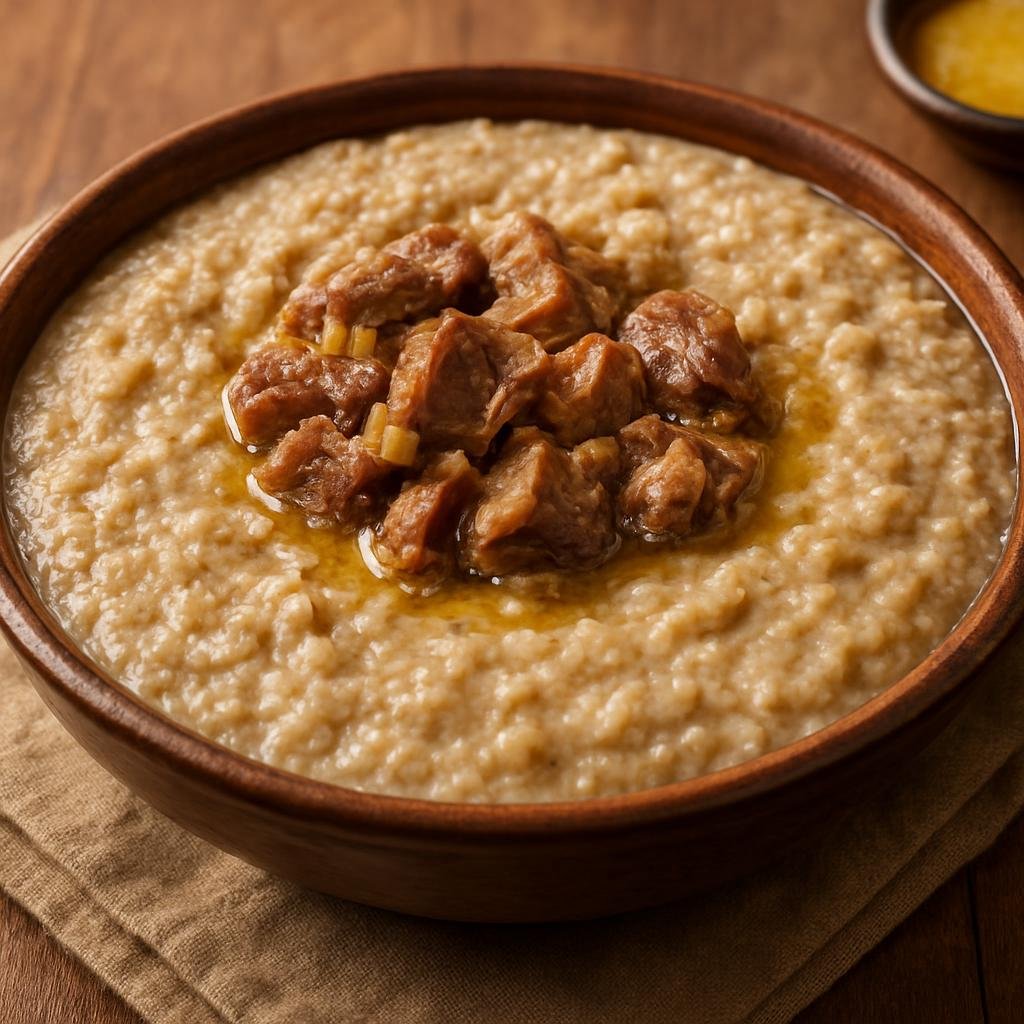
Serving Size: 6
Approximate Time
Prep
20 min
Cook
2 hrs 15 min
Total
2 hrs 30 min
Ingredients
- 4 lamb shanks, approx. 2 lb (900 g) total
- 2 cups (360 g) whole wheat berries, soaked overnight
- 8 cups (1.9 L) lamb or chicken stock (or water)
- 1 large onion, finely chopped, approx. 1 cup (150 g)
- 1 large onion, thinly sliced for frying, approx. 150 g
- 4 tbsp (60 ml) ghee or unsalted butter, plus extra for serving
- 2 tsp (4 g) ground cinnamon
- 1 tsp (2 g) ground cumin
- 1 1/2 tsp (9 g) salt, adjust to taste
- 1/2 tsp (1 g) ground black pepper
- 2 bay leaves
- 2 tbsp (30 ml) vegetable oil for frying onions
- 2 tbsp (25 g) granulated sugar (optional, for serving)
Instructions
1. Rinse the soaked wheat thoroughly. In a large heavy pot, combine lamb shanks, chopped onion, bay leaves, cinnamon, cumin, salt, pepper, and stock. Bring to a simmer, cover, and cook gently for 1.5–2 hours until the lamb is very tender and falling from the bone.
2. Remove lamb shanks; strain and reserve cooking liquid. Debone and shred the meat, discarding excess fat and bones. Return shredded meat to the pot with the drained wheat. Add additional cooking liquid as needed to cover the wheat by about 1 inch.
3. Simmer the wheat and meat mixture gently, uncovered, stirring occasionally and pressing the grains against the side of the pot with a spoon or using an immersion blender briefly, until the wheat breaks down and the mixture becomes a thick, smooth porridge (about 45–60 minutes). Add more stock/water if it becomes too thick.
4. While the harees cooks, heat 2 tbsp (30 ml) oil in a skillet over medium heat. Fry the thinly sliced onion until deep golden and crisp; drain on paper towels.
5. Stir 4 tbsp (60 ml) ghee or butter into the finished harees for richness. Adjust seasoning. Serve hot, topped with fried onions and a drizzle of extra ghee; offer 2 tbsp (25 g) sugar and a sprinkle of ground cinnamon at the table if desired.
Estimated Nutritional Information*
Per serving | Servings: 6
Calories: 504 kcal
Carbohydrates: 55.2 g
Protein: 21.1 g
Fat: 23.8 g
Saturated fat: 10.4 g
Cholesterol: 74 mg
Fiber: 8.6 g
Sodium: 650 mg
Potassium: 498 mg
Calcium: 60 mg
Iron: 4.37 mg
Vitamin A: 72 µg RAE
Vitamin C: 3.8 mg
Generated: 2026-11-06T06:02:59+00:00
*Values are estimates based on USDA data and mathematical calculations. Actual values may vary. Where data are unavailable, those contributions are excluded.