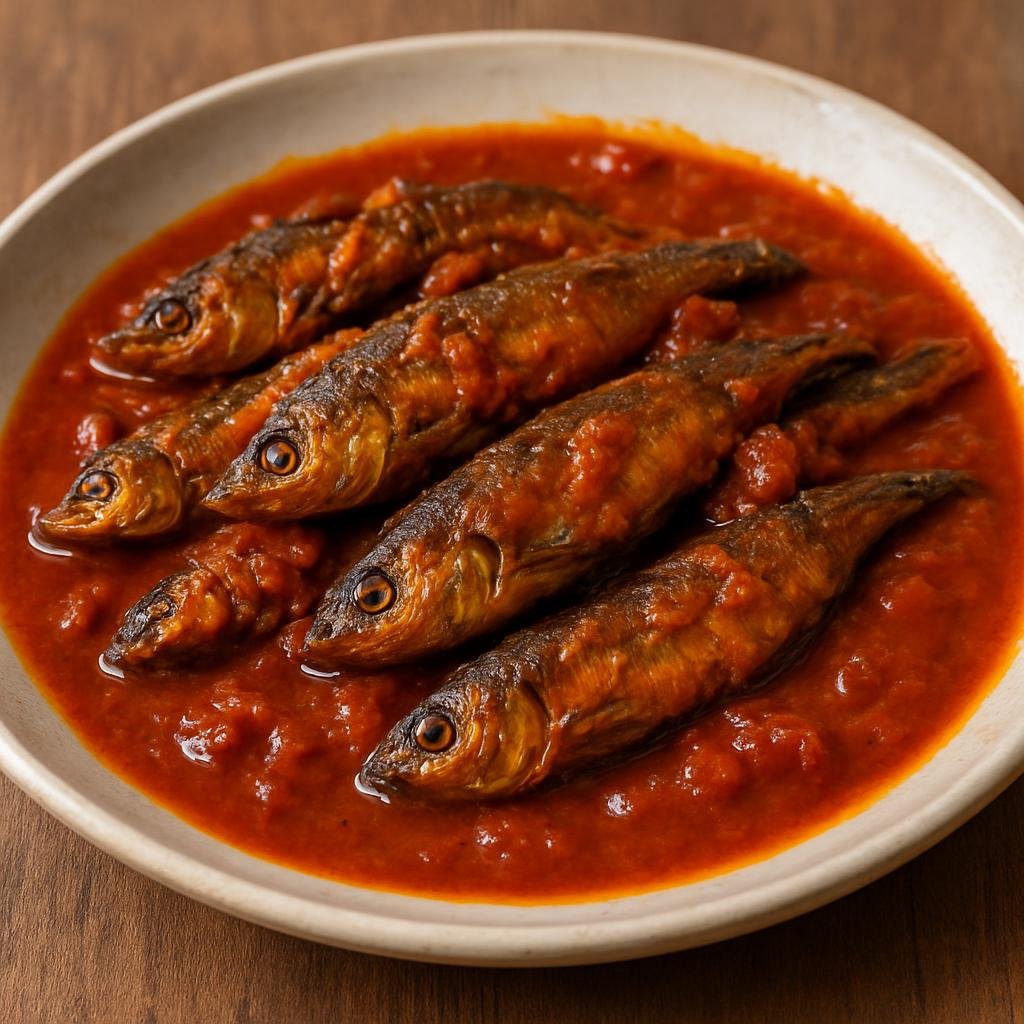
Entree: Republic of the Congo – National Cuisine – Ndakala (Stewed small smoked freshwater fish in a rich palm-oil and tomato sauce)
Food safety reminder: Follow safe food-handling practices and use a food thermometer to verify safe internal cooking temperatures.
Serving Size: 4
Approximate Time
Prep
15 min
Cook
28 min
Additional
15 min
Total
55 min
Ingredients
450 g (1 lb) cleaned small ndakala, smoked and dried
3 tbsp (45 ml) red palm oil
1 medium onion, thinly sliced (about 110 g edible)
3 garlic cloves, minced (about 9 g edible)
2 cups chopped ripe tomatoes (about 360 g edible)
1 tbsp tomato paste (about 16 g)
1 whole Scotch bonnet pepper, left whole or pierced
1 cup (240 ml) fish stock, or water
1 tsp bouillon powder or crumbled bouillon cube (optional; choose one)
1/2 tsp ground black pepper
Salt, to taste; add sparingly because the smoked fish and optional bouillon may be salty
1 tbsp chopped fresh parsley (about 4 g), for garnish
1 1/2 cups (300 g) uncooked long-grain white rice
3 cups (720 ml) water, for cooking the rice
Instructions
1. Briefly rinse the cleaned smoked-dried ndakala under cold water and pat dry. If it is particularly salty, soak for 10 minutes, then rinse and drain.
2. Heat 2 tablespoons of the palm oil in a large skillet or Dutch oven over medium heat. Fry the fish for 1–2 minutes per side, then transfer it to a plate.
3. Add the remaining tablespoon of oil to the pot. Cook the sliced onion for about 5 minutes, until translucent.
4. Stir in the garlic and tomato paste and cook for 1 minute. Add the chopped tomatoes and cook for 6–8 minutes, stirring occasionally, until they begin to break down.
5. Add the fish stock or water, whole Scotch bonnet, optional bouillon, and black pepper. Stir to combine.
6. Return the fish to the pot, nestling it into the sauce. Cover and simmer gently over low heat for 10–12 minutes.
7. Meanwhile, rinse the rice until the water runs mostly clear. Combine it with 3 cups water in a saucepan and bring to a boil. Cover, reduce the heat to low, and simmer for 15–18 minutes, until tender. Fluff with a fork.
8. Taste the stew and add salt sparingly as needed. Remove the Scotch bonnet if desired. Sprinkle with chopped parsley and serve the stew over the cooked rice.
Estimated Nutritional Information*
Per serving | Servings: 4
Calories: 549 kcal
Carbohydrates: 69.2 g
Protein: 28.1 g
Fat: 17 g
Saturated fat: 6.6 g
Cholesterol: 72 mg
Fiber: 3 g
Sodium: 347 mg
Potassium: 799 mg
Calcium: 139 mg
Iron: 5.05 mg
Vitamin A: 109 µg RAE
Vitamin C: 34.6 mg
Generated: 2026-11-06T15:21:48+00:00
*Values are estimates based on USDA data and mathematical calculations. Actual values may vary. Where data are unavailable, those contributions are excluded.