Entree: United States – Rotisserie Prime Rib
Food safety reminder: Follow safe food-handling practices and use a food thermometer to verify safe internal cooking temperatures.
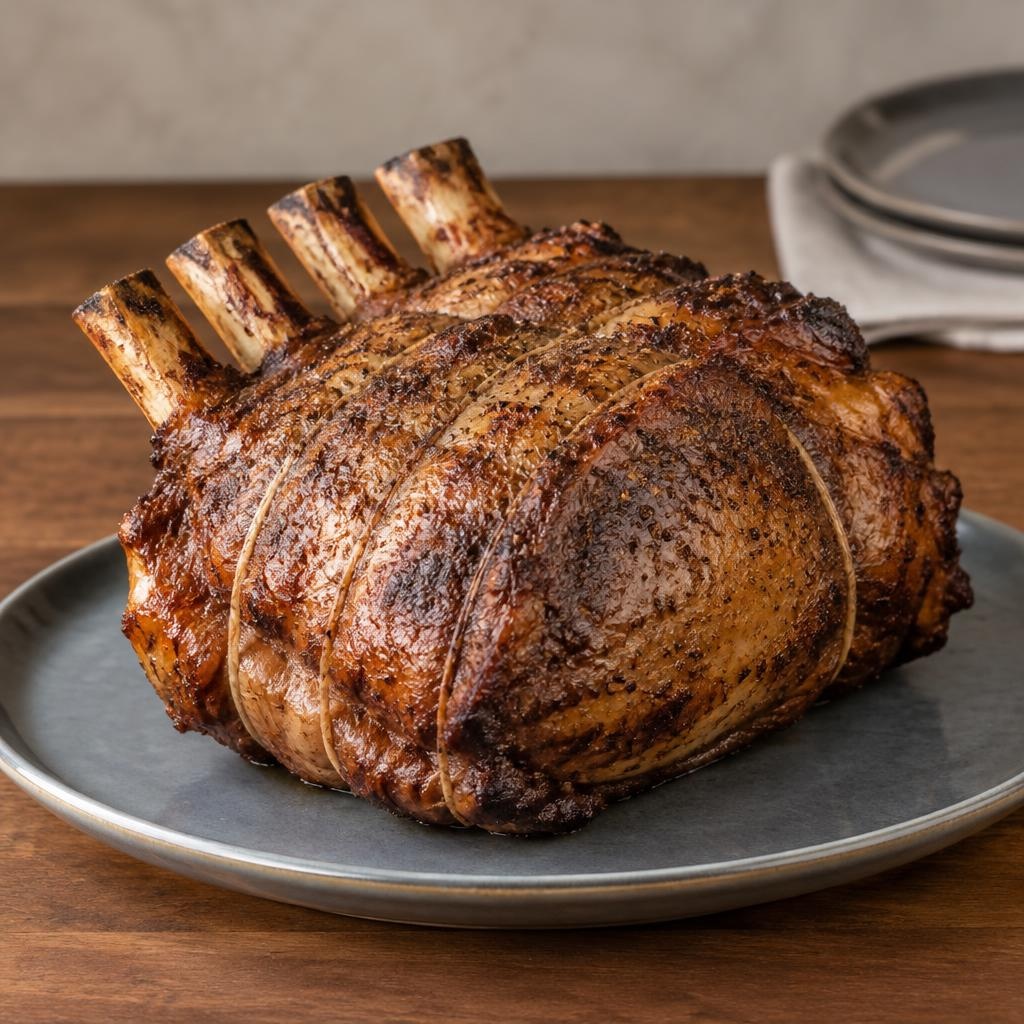
Serving Size: 6
Approximate Time
Prep
20 min
Cook
1 hr 30 min
Additional
1 hr 45 min
Total
2 hrs 20 min
Ingredients
- 1 bone-in rib roast (standing rib roast), approx. 6 lb (2.7 kg) total
- salt, to taste
- black pepper, to taste
- water, as needed
Instructions
1. Remove the roast from refrigeration 1–2 hours before cooking to come closer to room temperature.
2. If the roast is not already tied, tie the roast between bones with butcher's twine at 1–2 inch (2.5–5 cm) intervals so it keeps a uniform shape for even rotation. Pat the surface dry with paper towels and season all over with salt, to taste and black pepper, to taste.
3. Preheat the rotisserie to high heat for searing, about 450°F (230°C) if your unit shows temperatures; set up for indirect heat if possible (flame off under the meat after sear or lower flame intensity).
4. Thread the roast onto the spit, centering it and securing firmly with the rotisserie forks on each side. Test balance so the spit turns smoothly without strain.
5. Place the spit in the rotisserie and sear the roast at high heat for 10–15 minutes, rotating until the fat cap and surface are well browned.
6. After searing, reduce heat to medium (around 325°F / 160°C equivalent on your rotisserie) and continue cooking on the spit. Roast time will vary by size and rotisserie; plan roughly 12–15 minutes per pound as a guideline while monitoring internal temperature.
7. Use an instant-read meat thermometer inserted into the thickest part (not touching bone) and remove the roast when it reaches your target: 120–125°F (49–52°C) for rare, 130–135°F (54–57°C) for medium-rare, 140°F (60°C) for medium. Expect 5–15°F (3–8°C) carryover rise during resting.
8. Carefully remove the spit, transfer the roast to a cutting board, tent loosely with foil, and rest 20–25 minutes to allow juices to redistribute.
9. Carve between the bones into individual rib steaks or slice the eye of the roast against the grain to desired thickness. Serve immediately with the natural juices; add water sparingly only if needed to thin pooled juices for serving.
Estimated Nutritional Information*
Per serving | Servings: 6
Calories: 1157 kcal
Protein: 62.5 g
Fat: 98.7 g
Saturated fat: 40.7 g
Cholesterol: 265 mg
Sodium: 208 mg
Potassium: 1028 mg
Calcium: 34 mg
Iron: 6.58 mg
Generated: 2026-11-05T20:05:08+00:00
*Values are estimates based on USDA data and mathematical calculations. Actual values may vary. Where data are unavailable, those contributions are excluded.