Entree: United States – Appalachian and Southern United States (Kentucky) – Fried Chicken
Food safety reminder: Follow safe food-handling practices and use a food thermometer to verify safe internal cooking temperatures.
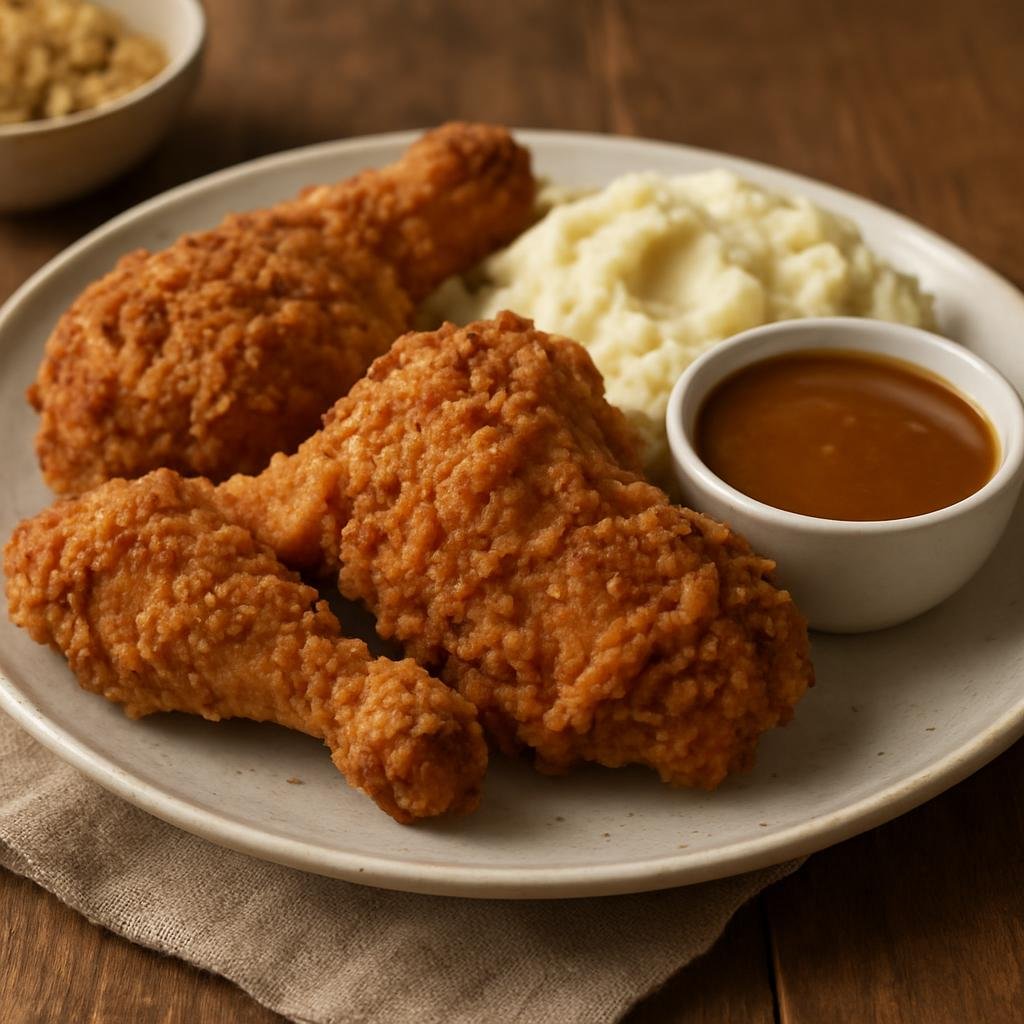
Serving Size: 6
Approximate Time
Prep
25 min
Cook
45 min
Additional
8 hrs
Total
8 hrs 30 min
Ingredients
8 bone-in, skin-on chicken pieces (mix of thighs, drumsticks, breasts), approx. 3.5 lb (1.6 kg) (estimated edible portion: 1200 g)
4 cups (960 ml) buttermilk
1 tbsp (15 ml) kosher salt (for marinade)
1 tsp (5 ml) freshly ground black pepper (for marinade)
1 tsp (5 ml) hot sauce (optional; for marinade)
3 cups (360 g) all-purpose flour
1 tbsp (15 g) cornstarch
2 tbsp (30 g) paprika
1 tbsp (15 g) garlic powder
1 tbsp (15 g) onion powder
2 tsp (10 g) kosher salt (seasoned flour) (estimated edible portion: 10 g)
1 tsp (5 g) ground black pepper
1 tsp (5 g) cayenne pepper (adjust to taste)
1 tsp (1 g) dried thyme
1 tsp (5 g) white pepper (optional)
2 large eggs, beaten with 2 tbsp (30 ml) water (egg wash)
1.5–2 qt (1.4–1.9 L) peanut oil or vegetable oil for frying; select peanut oil
2 lb (900 g) russet potatoes, peeled and cut into 1–2 inch pieces (mashed potatoes)
1/2 cup (120 ml) whole milk (for potatoes)
4 tbsp (60 g) unsalted butter (for potatoes)
1 tsp (5 g) salt (for potatoes)
1/2 tsp (2.5 g) black pepper (for potatoes)
4 cups (about 340 g) shredded green cabbage (coleslaw)
1 cup (100 g) shredded carrots (coleslaw)
1/2 cup (120 ml) mayonnaise (coleslaw)
1/2 cup (120 ml) buttermilk (coleslaw dressing)
1 tbsp (15 ml) apple cider vinegar (coleslaw)
1 tbsp (15 g) granulated sugar (coleslaw)
1/2 tsp (2.5 g) salt (coleslaw)
1/4 tsp (1.25 g) black pepper (coleslaw)
Instructions
1. Marinate the chicken: In a large bowl or resealable bag, combine the buttermilk, marinade salt, marinade black pepper, and optional hot sauce. Add the chicken pieces, making sure they are coated and submerged as much as possible. Cover and refrigerate for 4–12 hours, preferably overnight.
2. Prepare the coleslaw: Whisk together the mayonnaise, coleslaw buttermilk, apple cider vinegar, sugar, coleslaw salt, and coleslaw black pepper. Toss with the shredded cabbage and carrots. Cover and refrigerate until serving.
3. Cook the potatoes: Put the peeled, cut potatoes in a pot and cover with cold water. Add the potato salt, bring to a boil, then simmer for 15–20 minutes, until fork-tender. Drain and cover.
4. Make the seasoned flour: In a wide, shallow dish, whisk together the flour, cornstarch, paprika, garlic powder, onion powder, seasoned-flour salt, ground black pepper, cayenne, dried thyme, and optional white pepper.
5. Set up the coating station: Beat the eggs with the water in a shallow bowl. Set out the seasoned flour, egg wash, and a wire rack. Remove each chicken piece from the marinade and let excess buttermilk drip off.
6. Coat the chicken: Dredge each piece in seasoned flour and shake off excess. Dip it in the egg wash, then dredge it in the flour again, pressing the coating onto the chicken. Place the coated pieces on the rack and rest for 10–15 minutes.
7. Heat the frying oil: Pour 1.5–2 qt (1.4–1.9 L) peanut oil into a heavy skillet or Dutch oven to a depth of about 1–1.5 inches. Heat to 325–350°F (160–175°C), monitoring with a thermometer.
8. Fry the chicken in batches without crowding the pan. Start skin-side down and cook, turning once, until deeply golden and the thickest part of each piece reaches 165°F (74°C). This will take about 12–15 minutes for thighs and drumsticks and 10–12 minutes for smaller pieces; larger pieces may need up to 16 minutes. Adjust the heat as needed to keep the oil in range.
9. Transfer cooked chicken to a wire rack set over a baking sheet and rest for 5–10 minutes. If needed, keep batches warm in a 200°F (95°C) oven while frying the remaining pieces.
10. Finish the mashed potatoes: Mash the drained potatoes with the whole milk, butter, potato salt, and potato black pepper until smooth and creamy. Add a little more milk or butter if desired.
11. Serve the fried chicken with mashed potatoes and chilled coleslaw. Offer additional hot sauce, pickles, or warm biscuits if desired.
Estimated Nutritional Information*
Per serving | Servings: 6
Calories: 3351 kcal
Carbohydrates: 101.2 g
Protein: 52 g
Fat: 309.6 g
Sodium: 2668 mg
Potassium: 1821 mg
Calcium: 346 mg
Iron: 7.18 mg
Vitamin C: 41.9 mg
Generated: 2026-11-06T07:55:16+00:00
*Values are estimates based on USDA data and mathematical calculations. Actual values may vary. Where data are unavailable, those contributions are excluded.